Showing posts with label National Bureau of Economic Research. Show all posts

Wednesday, July 10, 2013

History -- not quite what we thought

Hamlin Garland is not now a household word, if he ever was, and his late-Victorian writing style hasn't helped. But those seeking a realistic portrait of pioneering in the upper Midwest (Wisconsin, Iowa, South Dakota) will enjoy reading A Son of the Middle Border. He spent his boyhood, youth, and young manhood pioneering and ended in 1893 telling his father Richard,

Father, you've been chasing a will-o'-the-wisp. For fifty years you've been moving westward, and always you have gone from certainty to uncertainty, from a comfortable home to a shanty. For thirty years you've carried mother on a ceaseless journey -- to what end? Here you are - snowbound on a treeless plain with mother old and crippled.... You must take the back trail.
This message may be unwelcome to many 21st-century genealogists, as it was to the old Civil War veteran. But it's closer to real life than the sentimental sketches in the mug books being published around the same time.

Hamlin Garland was a man of his time. He maintained, and probably believed, the fiction that the Indians just "melted away" before white settlement. His critique of pioneering had nothing to do with the immorality of white people's stealing Indian land; it had to do with the resultant quality of life for the white people themselves.


A completely different approach to a similar subject is a recent working paper by economists on the results of the 1832 Cherokee land lottery, in which land recently "acquired" from Indians was offered at random to white settlers. The economists compared those who received the windfall with those who did not, using 1850 census data, and found that most of the benefits accrued, not to the poorest, but to middling and wealthy.
Almost two decades after the lottery, winners were, on average, $700 richer than a comparable population that did not win the lottery. The gains in wealth, however, are not evenly distributed among the lottery winners. Indeed, the poorest third of lottery winners were essentially as poor as the poorest third of lottery losers.
History is rarely what we expect; no wonder the future is so surprising.


Hamlin Garland, A Son of the Middle Border (New York: Macmillan, 1917).

Hoyt Bleakley and Joseph Ferrie, "Up from Poverty? The 1832 Cherokee Land Lottery and the Long-run Distribution of Wealth," National Bureau of Economic Research Working Paper, 21 June 2013 version (http://home.uchicago.edu/~bleakley/Bleakley_Ferrie_Up.pdf : viewed 5 July 2013).


Harold Henderson, "History -- not quite what we thought," Midwestern Microhistory: A Genealogy Blog, posted 10 July 2013 (http://midwesternmicrohistory.blogspot.com : accessed [access date]). [Please feel free to link to the specific post if you prefer.]  

Wednesday, January 16, 2013

Food for Thought on Immigration

Interesting results from three economists based on information from 195 countries and methodology that I am not competent to describe:

We show that birthplace diversity is . . . positively related to economic development even after controlling for education, institutions, ethnic and linguistic fractionalization, trade openness, geography, market size, and origin-effects.
Their introduction cites other papers pertaining to the 1870-1920 migration boom in the US. All this is not directly related to genealogy, but it is indirectly related to the extent that our "common-sense" assumptions about immigration and emigration in history can be wrong, and insofar as possible it helps us think about the particular if we have a better idea of what the general facts seem to be. These findings certainly suggest that, whatever else it does or did, the nativist response to immigration was not likely to lead to prosperity. The kind of common sense their research supports is this:
The reason why birthplace diversity could be bene…ficial for productivity is due
to skill complementarity. People born in different places are likely to have dif-
ferent productive skills because they have been exposed to different experiences,
different school systems, different "cultures" and thus have developed different
perspectives that allow them to interpret and solve problems differently. These
differences can be complementary and lead to higher productivity.


Alberto Alesina, Johann Harnoss, and Hillel Rapoport, "Birthplace Diversity and Economic Prosperity," third draft, January 2013, National Bureau of Economic Research Working Paper no. 18699 (http://www.economics.harvard.edu/faculty/alesina/unpublished_papers_alesina : accessed 14 January 2013). 


Harold Henderson, "Food for Thought on Immigration," Midwestern Microhistory: A Genealogy Blog, posted 16 January 2013 (http://midwesternmicrohistory.blogspot.com : accessed [access date]). [Please feel free to link to the specific post if you prefer.]


Wednesday, November 18, 2009

Context files: Did your ancestor clear a Midwestern farm in the 1850s?

Economists Jeremy Atack and Robert Margo have confirmed what most of us might have expected: that the coming of the railroads in the 1850s did encourage Midwestern farmers to clear more land. That's the gist of their new paper at the National Bureau of Economic Research (full access by purchase or university affiliation).

The authors identified 278 counties in Ohio, Michigan, Indiana, Illinois, Wisconsin, Iowa, and Missouri that didn't change their boundaries, and compared land-clearing activity in counties that got a railroad during the 1850s with those that didn't. For many reasons the figures can't be precise, but they figure that between 1/4 and 2/3 of the land-clearing activity was inspired by railroad access, and the cheaper transportation and higher crop prices that it promised.

"Whatever else might have led Midwestern farmers to undertake the back-breaking labor of clearing their land," they conclude, "no other single factor seems likely to be as important as the potential gains from trade deriving from the arrival of the Iron Horse."

Thursday, April 2, 2009

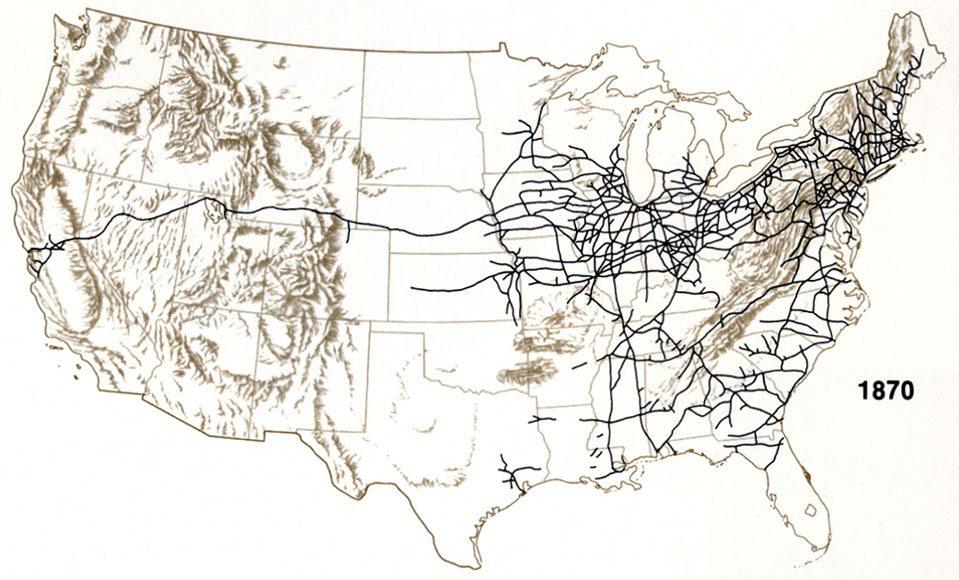
Getting There in 1848 and 1870

"Did Railroads Induce or Follow Economic Growth? Urbanization and Population Growth in the American Midwest 1850-1860" (PDF, National Bureau of Economic Research) Four economists have researched the effect of railroad development on Midwestern settlement between 1850 and 1860. If you're like me, you'll read the introduction and the historical information about how fast the new transportation mode developed (and how Ohio tried to quash it to protect the state's investment in canals!), skip most of the technical part, and check out the conclusions. It turns out that (if I have got it right) railroads didn't speed up settlement, but they did speed up urbanization. Not surprising given that they can't stop everywhere and therefore are a centralizing technology.

And then you'll discover that they footnote some very interesting old railroad and ship travel guides. (In order to measure the effect of railroads, they had to know exactly where they were when.) The links didn't all work for me. These are the ones I found, either directly or after a little fooling around, and I'm pretty sure there are more. These are extremely cool resources if you have folks migrating to or through the Old Northwest in this era:

Appletons' Railroad and Steamboat Companion
, 1848 (Google Book Search)

1870 railroad map, not sourced

Travelers' Official Guide of the Railways and Steam Navigation Lines of the United States & Canada, June 1870. Note the prematurely psychedelic cover typography and the long list of local times.

Grain Dealers' and Shippers' Gazetteer, evidently 1891 (as digitized by Pam Rietsch), accessible one railroad line at a time. The maps are awesome; the gazetteer part contains names as well.

For further searching, check out the University of Texas's justly famous Perry-Castaneda Map Collection (no tilde available on blogger?).

Wednesday, September 24, 2008

Did your ancestor do time in Pennsylvania in the 1800s?

Lafayette College economist Howard Bodenhorn has studied patterns of criminal sentencing in mid-19th-century Pennsylvania, and the National Bureau of Economic Research has put an abstract of his working paper #14283 on the web. In short,

The observed disparities [in sentencing] in the mid-nineteenth century . . . are different than modern disparities. Instead of longer sentences, African Americans and recent immigrants tended to receive shorter sentences, whereas more affluent offenders received longer sentences. The results are consistent with other interpretations of the period as the "era of the common man."
(Gee, I wonder what kind of era we're living in?)

If that makes you want to read the whole thing, you'll either have to pay $5 or get next to an academic database.

Check his list of publications on the web site for leads on some more offbeat angles on genealogy, such as "Single Parenthood and Childhood Outcomes in the Mid-Nineteenth Century Urban South" and "Colorism, Complexion Homogamy and Household Wealth: Some Historical Evidence."